How AI Can Make Your Avatar Your Secret Weapon

A few weeks ago, my health insurance company screwed something up and sent me a bill for the wrong amount. It wasn't life-shattering or anything like that, but it did necessitate several hours of waiting on hold, being told I needed to speak to another department, waiting on hold more, repeating the same data over and over, and slowly losing faith in humanity. When it was finally resolved, the cost of the time I spent was almost as much as the cost of the mistaken bill.

There really and truly has to be a better way to live, and AI and avatars can be a step towards a solution. At a talk I gave at the University of Michigan a few weeks ago, I presented the idea of a small language model -- basically, you consent to the model pulling from your own data to create an avatar. This avatar can then do all the work you don't want to do while you enjoy your life.

For instance, your avatar can do all those initial sales meetings that turn out to be a time sink nine out of ten times. In the case where the meeting is useful, it will alert the humans and connect them, and screen out all the bad fits. It will make all those mundane calls to the credit card company and the salon to fix mistakes and make appointments. In a dream world, it could even be sent out to deal with your boring relatives ("oh, your kid is potty-training? Sounds fascinating...") while you spend time with people you actually like.

There are, of course, downsides as these bots could be programmed to spread misinformation and lies -- but that's really not all that different from the current state of Twitter. And while some jobs would be lost, others would be gained, and people would be able to get back time to focus on things they are actually good at and enjoy.

If you're interested in learning more about this, drop me a line.

The Power of Big Feelings in XR

Directing in VR is challenging. Because you shoot in 360, you can't actually be in the space, so the director winds up watching through a monitor. And while the director can capture most of the big picture, it really falls on the talent to nail the subtleties.

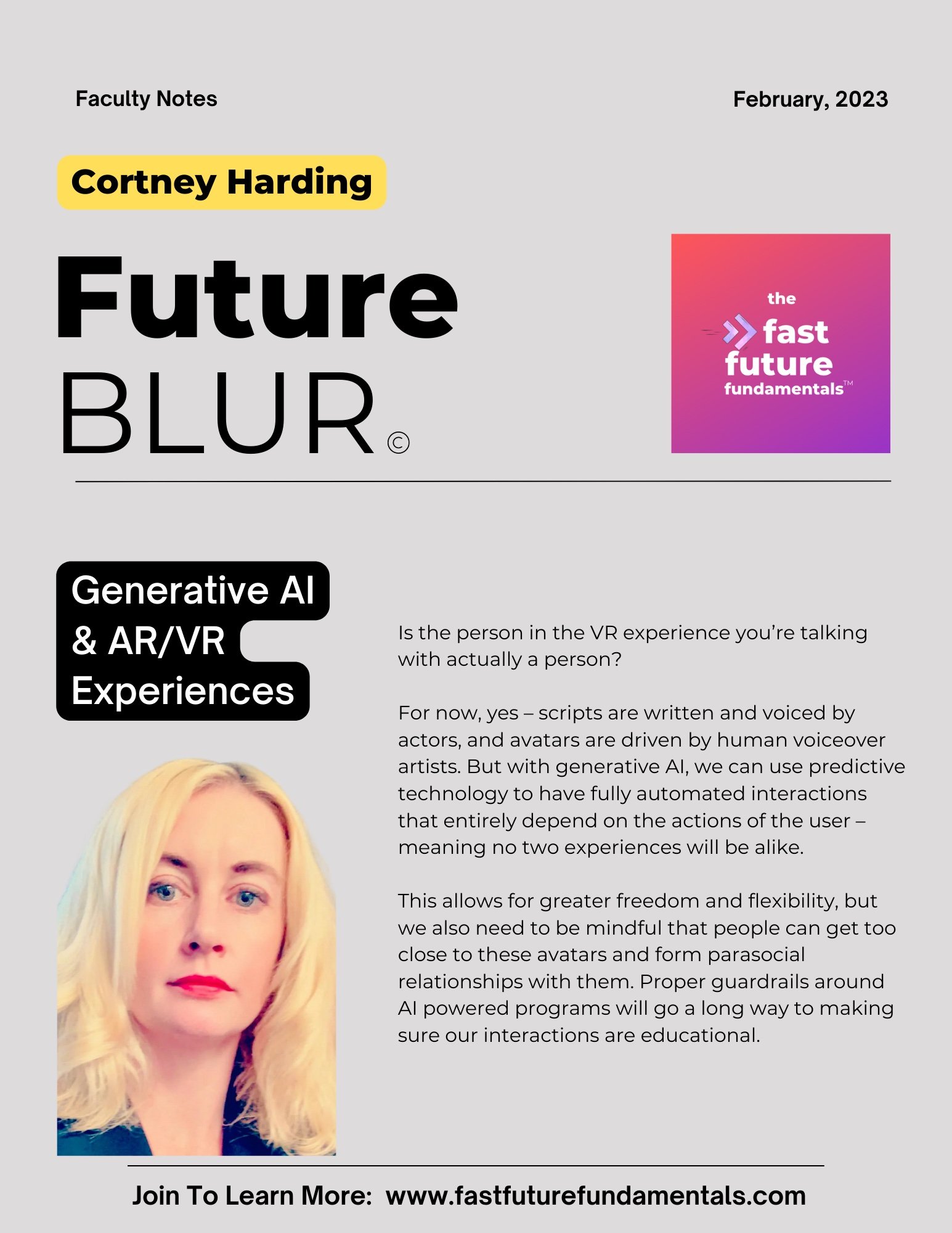
So I was delighted when I watched the most recent piece I worked on with the incredible director Pamela Jaber and the woman pictured above absolutely eviscerated my soul with one simple word. In the piece, the user is experiencing workplace bullying, and towards the start mentions something they are excited about. To which their co-worker replies, deadpan, "cool." It is every mean high school experience in one second, and even though I helped write the script and was there when it was filmed, my soul died just a little.

For someone who has never been on the end of that treatment, that can be an earth shattering moment. Finally understanding what it is like to be on the end of bullying incident, or a bias incident, or harassment, can have a profound effect. I've seen real and concrete organizational change come from this, and workplaces improve because of it.

And this is where I get so frustrated with the tech bro bloggers who seem to love dancing on the grave of XR. Ok, so Horizon Worlds isn't your thing -- fine. How about increased empathy in the workplace? How about vastly improved grades at a historically Black college using the metaverse to teach? How about a new program where headsets are being brought into juvenile prisons so youth offenders can learn trades and get jobs? Do you want to gleefully spit on that, too?

The fact is, this technology continues to evolve and grow and have real impact. If you're down with ignoring the hype and making real, concrete, lasting change, drop me a line.

Rumors of the metaverse's demise have been greatly exaggerated

Welcome back to the Friends With Holograms newsletter. We took a bit of a hiatus from publishing (although certainly not from consulting on and producing amazing XR and metaverse content) but now we’re back on a brand new platform. And we’re going to kick things off by addressing the elephant in the room: is the metaverse dead?

The tech press certainly loves to declare it, although the actual evidence the accompanies real reporting seems…rather thin. Meta, at present one of the market leaders in the space, released a roadmap of new headset launches, and while leaders there have expressed interest in building out AI products, they’ve made no claims that it will be at the expense of the company’s investment in XR and the metaverse. In fact, Nick Clegg released a long blog post yesterday detailing all the use cases for the metaverse in education.

When you really start digging, you start to see the truth — XR and the metaverse are being widely adopted. VictoryXR is building digital twins of college campuses for schools like South Dakota State, New Mexico State, and Southwestern Oregon Community College. Companies are buying headsets, building XR training sims, and seeing the same great results we’re been talking about for years.

And in the midst of a tech winter, shares in Roblox, the metaverse platform that is hugely popular with tweens and teens, are up 25%. Boy, that’s a sure sign of dying industry if ever there was one?

The fact is, the tech press loves clickbait, and there’s no better way to a flame war going than to declare something “dead” or “the future.” In the late nineties and early aughts, the internet was eulogized on several occasions; the demise of MySpace led to op-eds about the end of social networking. It’s all just part of the growth process.

Two months from now, once Apple releases its headset, we’re likely to see a big change in attitude. So if you’re on the fence, the time is right to get going and start building.

Please reach out to us if you’re interested in learning more about how we can help you figure all this out. And if you’re in Ann Arbor on Wednesday, come see Cortney at the University of Michigan XR Summit, where she’ll be talking about generative AI and the metaverse.